

The Romanian labor market in 2026 presents a very specific and unusually concentrated demand signal that reveals far more about structural economic change than most headline employment statistics. Among all open occupations, the single most in-demand role is “curier” (courier), with 2,981 active job openings across the country.
This figure is not simply a reflection of temporary hiring needs. It represents a deep structural shift in how goods, services, and consumption behavior are evolving in Romania’s urban economy. When a single occupation reaches nearly 3,000 open roles in a relatively small labor market, it signals systemic transformation rather than isolated demand.
To understand why courier jobs in Romania have reached this level of demand, it is necessary to place the figure within the broader context of Romania’s labor market structure. As previously established, Romania currently operates with 37,181 open positions, of which 26,303 are newly created expansion roles and only 10,878 are replacement-based vacancies. This means that 70.7% of labor demand is driven by economic expansion rather than workforce turnover.
Courier demand sits directly inside this expansion-driven system, but with a unique characteristic: it represents the physical endpoint of digital and service expansion.
According to Eurostat logistics and transport distribution data and European e-commerce growth analysis, last-mile delivery has become one of the fastest-growing employment segments across Europe due to sustained increases in online consumption and food delivery platform adoption.
Romania is one of the most visible expressions of this trend.
The 2,981 courier job openings are therefore not random. They are the labor manifestation of three converging economic systems: e-commerce scaling, food delivery platform expansion, and urban consumption acceleration.
Behind The 2,981 Courier Job Openings
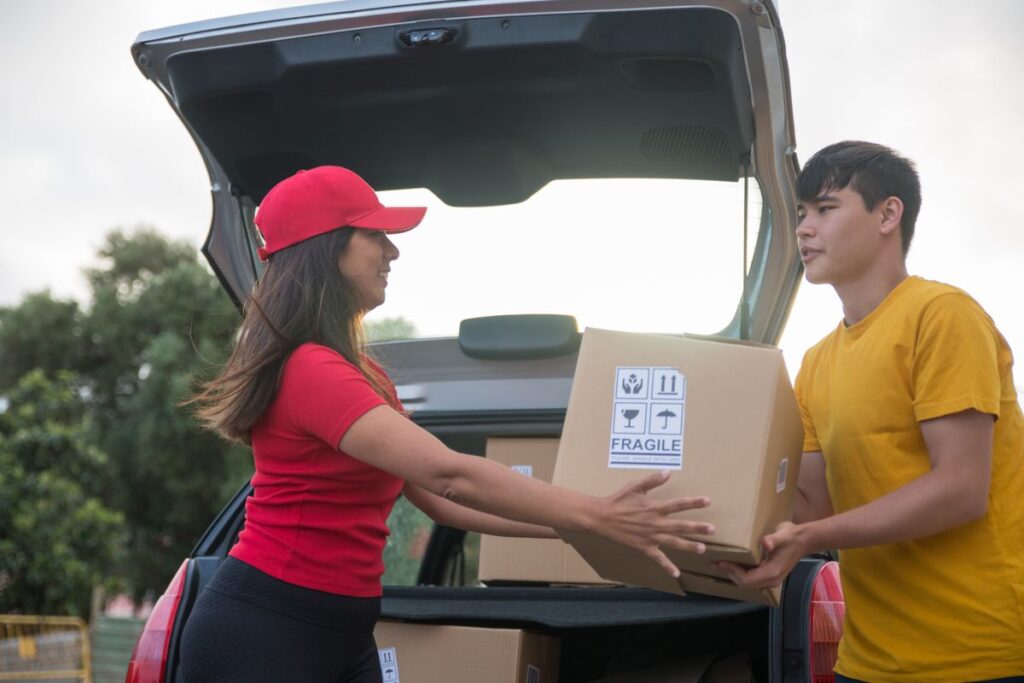
To interpret this number correctly, it is important to understand what courier roles actually represent in modern labor markets. A courier is no longer simply a traditional delivery worker. In 2026 Romania, couriers function as the physical infrastructure of digital consumption systems.
Every online order, restaurant delivery, grocery shipment, or retail fulfillment request eventually translates into a courier movement. This means courier demand is directly proportional to digital transaction volume.
The presence of 2,981 open courier roles indicates that Romania is experiencing a high-density expansion of last-mile logistics systems, particularly in urban centers such as Bucharest, Cluj-Napoca, Timișoara, and Iași.
Unlike manufacturing or construction jobs, courier roles scale almost immediately with demand increases. There is no long capital investment delay. This makes courier employment one of the most sensitive real-time indicators of consumer behavior growth.
Why E-Commerce Expansion Is the Core Driver of Courier Demand
The most significant driver behind courier job expansion in Romania is the continued growth of e-commerce penetration. According to OECD digital economy tracking and European retail transformation data, online retail adoption has been steadily increasing across Central and Eastern Europe, with Romania showing particularly strong growth rates due to rapid smartphone adoption and platform-based commerce expansion.
Each incremental increase in online shopping volume creates a direct proportional increase in last-mile delivery demand. Unlike traditional retail, where distribution is centralized, e-commerce distributes delivery points across thousands of individual endpoints.
This fundamentally increases logistical complexity.
Couriers become the final execution layer of the entire digital retail system. As e-commerce platforms scale, courier demand scales almost linearly.
The presence of 2,981 open courier positions indicates that this scaling is still in an active growth phase rather than a stabilized system.
Food Delivery Platforms as a Parallel Demand Engine
Alongside e-commerce, food delivery platforms represent the second major structural driver of courier demand in Romania.
Platforms operating in urban Romania have transformed food consumption behavior by shifting demand from physical restaurant visits to on-demand delivery ecosystems.
This has created a parallel logistics system that operates independently of traditional retail supply chains but uses the same courier labor pool.
Unlike e-commerce deliveries, food delivery demand is highly time-sensitive and concentrated in peak-hour cycles. This increases labor intensity per delivery unit and creates continuous demand for courier availability.
The result is a persistent structural shortage of courier capacity, even when overall employment levels remain stable.
This explains why courier vacancies remain elevated at nearly 3,000 roles despite fluctuations in other sectors of the labor market.
Also read: Construction Jobs in Romania Are Booming in May 2026: What Is Driving It and What It Pays
Urbanization and Consumption Density Effects
Courier demand is also strongly correlated with urban population density and consumption patterns.
Romania’s urban centers are undergoing consumption densification, where digital services are increasingly replacing physical service interactions. This creates localized spikes in delivery demand that require continuous labor supply.
Cities like Bucharest and Cluj-Napoca function as high-intensity consumption zones where courier systems operate at near-constant capacity.
The combination of dense population clusters and high digital adoption creates a structural environment where courier demand becomes persistent rather than cyclical.
Courier Jobs as a Proxy for Informal Digital Economy Expansion
Courier employment also reflects a broader transformation in Romania’s informal-to-platform economy transition.
Many courier roles operate within gig-based or semi-flexible employment structures, meaning they represent a hybrid between formal employment and platform-mediated labor.
According to European labor mobility and platform economy studies referenced by European Employment Services (EURES) , platform-based employment has been steadily increasing across EU member states, particularly in delivery and transport services.
Romania’s 2,981 courier vacancies are therefore not just a logistics signal. They are also a labor structure signal indicating increasing platform economy penetration.
Why Couriers Dominate Romania’s Labor Demand
The dominance of courier roles in Romania’s job market is significant because it represents the most direct translation of digital economic activity into physical labor demand.
Unlike technology roles, which support digital systems, couriers execute physical outcomes of those systems.
This creates a unique position in the labor hierarchy where courier roles function as the final output layer of multiple upstream economic systems including retail, hospitality, logistics, and digital platforms.
Courier Demand as the Clearest Signal of Romania’s Consumption Economy Expansion
The presence of 2,981 courier job openings in Romania is not an isolated labor statistic. It is a structural indicator of a rapidly expanding consumption-driven economy powered by digital platforms.
When interpreted alongside the broader 70.7% expansion hiring ratio in Romania’s labor market, courier demand becomes one of the clearest expressions of economic transformation occurring at the ground level.
Romania is not simply creating more jobs. It is creating a more digitally integrated consumption system that requires continuous physical execution through courier labor.




I’m a Pakistani nationals and working in Bahrain as delivery driver.I have both countries driving license Pakistani LTV+bike and Bahraini light vehicle driver’s license.I want to move from GCC to Romania or any other European country